
How Centrifugal Pumps Work
Centrifugal pumps are mechanical devices designed to move fluids by converting mechanical energy into kinetic energy. These pumps have several components which all have a key role in achieving this operation.
What’s an Impeller?
The impeller is what some would consider the heart of any centrifugal pump, as it is responsible for accelerating fluid outward from the center of rotation. This is what allows the pump to generate enough pressure to drive the fluid through the discharge point.
The Difference Between Open & Enclosed Impellers
One of the core reasons why enclosed impellers are superior is that they utilize two shrouds, one on the top and one on the bottom, resulting in a much stronger structure. The purpose of the shroud is to direct water gradually from the eye of the impeller, through vane passages to the impeller tip. Since both shrouds are connected to the enclosed impeller, they move with it as it spins, which helps minimize the wear rates.
Conversely, since the open impeller do not have shrouds, stationary wear plates are used in their place which do not rotate with the impeller. Open impellers tend to experience higher wear and lower efficiency, especially in high-pressure or abrasive applications. As a result, enclosed impellers can provide the same level of performance as an open impeller, but with a lower velocity relative to the spinning impeller vanes and shrouds, creating a much higher efficiency rating.
Enclosed Impeller Centrifugal Pump Applications
Enclosed impellers perform best in situations where efficiency, pressure, and wear resistance are top priorities. Because the liquid is fully contained between front and back shrouds, enclosed designs maintain tighter clearances and minimize recirculation losses — making them ideal for clean or lightly contaminated fluids.
Common applications include:
- Water supply & distribution – Municipal water systems, irrigation, and booster stations benefit from the high efficiency and consistent head that enclosed impellers provide.
- Industrial process pumping – Widely used in chemical plants, refineries, food & beverage processing, and power generation, where steady pressure and reliability are essential.
- Agriculture & irrigation – Delivering water over long distances or at high lift points while keeping energy costs low.
- Marine systems – Handling ballast, bilge, and cooling water in environments that demand dependable performance.
- Clean wastewater & stormwater transfer – Managing clear or lightly screened liquids that don’t carry abrasive solids.
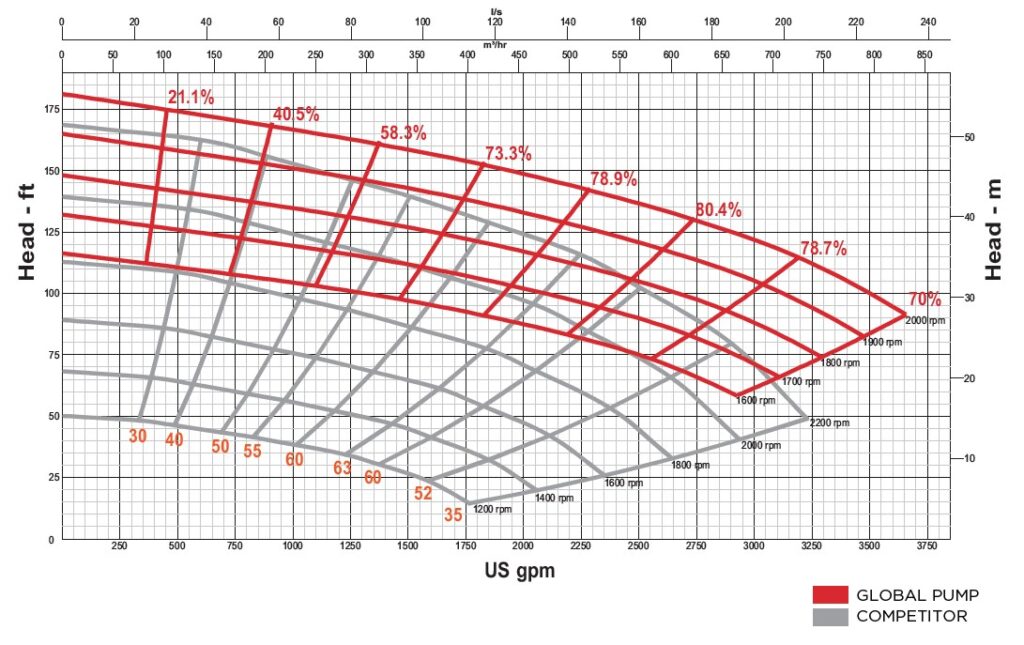
Impeller Efficiency
At Mersino, we use enclosed impellers in our centrifugal pumps because they consistently outperform open designs in terms of efficiency and durability. For instance, the example above compares the efficiency of an 8” Global Pump using an enclosed impeller and an 8” competitor pump using an open impeller.
Overall, choosing our pumps with enclosed impellers over those of our competitors will lead to
- Efficiency ratings up to 40% higher than our competition
- Lower engine power requirements
- Improved fuel consumption
- Less wear and tear
- Reduced maintenance and service times
- Longer run time per unit of fuel
When deciding between enclosed or open impeller options, it is crucial that you choose the enclosed impeller, which offers superior performance in even the most demanding conditions.
Choose Mersino for Your Centrifugal Pump Needs
With 30 plus years of experience across a variety of industries, we’re equipped to tackle the toughest of projects. Contact our team today to learn more about our expert water solutions.

